
Think of a business proposal not just as a document, but as a conversation starter with a Shopify merchant. It’s your formal pitch to a potential client, showing them exactly how your agency or expertise can solve their specific e-commerce problem. This isn't just about listing your services; it’s about crafting a compelling argument that convinces them to hire you for a particular project.
In short, it’s the blueprint for their success on Shopify, designed and built by you.
What Exactly Is a Business Proposal

Let’s get practical. Imagine a Shopify store owner is pulling their hair out over a high cart abandonment rate. They see the sales slipping away but have no idea why it's happening or how to fix it.
A weak proposal would just send a price list for "Shopify development." A great business proposal, on the other hand, dives deep. It diagnoses their specific issues—maybe it’s a clunky checkout process or surprise shipping costs—and presents your Shopify expertise as the precise cure for what ails them.
This document bridges the gap between the client’s headache and your custom-built solution. It moves beyond a simple quote by explaining the how and the why behind your strategy, giving the client a clear, actionable path to recovering that lost revenue.
Proposal vs. Plan: A Critical Distinction
This is a big one. People mix up business proposals and business plans all the time, but they’re two completely different beasts serving entirely different purposes. For anyone working with Shopify clients, nailing this distinction is fundamental.
A business proposal is a sales document. Its sole purpose is to win a specific project from a specific client. A business plan, however, is your internal playbook. It maps out your own company's future.
A business proposal is an external sales tool aimed at a specific Shopify merchant to win a project. A business plan is an internal roadmap for your own agency's strategy, operations, and growth.
For instance, your proposal might detail a plan to implement a new loyalty program app for a client to boost customer retention. Your business plan, meanwhile, would outline your agency's goal to increase its own revenue by 20% over the next fiscal year by specializing in Shopify Plus migrations. One is for them, the other is for you.
To make this crystal clear, here’s a quick breakdown of how these two documents stack up against each other.
Business Proposal vs Business Plan Key Differences
| Attribute | Business Proposal | Business Plan |
|---|---|---|
Purpose | To sell a specific Shopify project or service | To outline a company's goals and strategy |
Audience | External (a prospective Shopify merchant) | Internal (founders, investors, leadership) |
Focus | A client's specific Shopify problem and your solution | The entire business operation and its growth |
Timeline | Project-specific (short-term) | Long-term (1-5 years) |
Core Question | "How will we solve your Shopify store's problem?" | "How will our agency succeed?" |
This table shows at a glance that while both are crucial, they operate in completely different arenas. Mixing them up means you’re either trying to sell your internal strategy to a client or writing a sales pitch for your own team—neither of which works.
The Core Purpose in the Shopify World
At its heart, a business proposal is all about persuasion. It's your shot to prove you're the right partner to help a merchant crush their goals on Shopify. To get that "yes," your proposal needs to hit several key targets:
- Show You Get It: The client needs to see that you've actually listened. Your proposal should echo their pain points, whether it’s a slow-loading theme, a messy product page, or a clunky mobile experience on their Shopify store.
- Offer a Custom Fix: A copy-paste solution screams laziness. You need to detail the specific services you’ll provide—like a custom theme build or a Klaviyo integration—and explain why these are the right moves for their Shopify store.
- Build Instant Trust: Nothing builds credibility like clarity. A detailed scope of work, a realistic project timeline, and transparent pricing show you’re a pro who knows their stuff.
- Set Clear Expectations: This document is your first line of defense against scope creep and misunderstandings. It clearly defines deliverables, timelines, and costs, getting everyone on the same page from day one.
Ultimately, a winning proposal makes the client feel heard, understood, and confident that you can deliver. It’s the first step in building a great partnership.
The Anatomy of a High-Converting Shopify Proposal
A great business proposal is much more than a price list. It’s a story. A persuasive argument. It’s your chance to show a potential Shopify merchant you don’t just build websites—you solve business problems. Think of it like a blueprint for a high-performance engine. Every single part has a job, and when they all fire in sync, the result is pure power. For any Shopify pro, mastering this structure is what turns a hopeful pitch into a signed contract.
This isn't just about showing what you can do; it's about building a bridge from their problem to your solution.
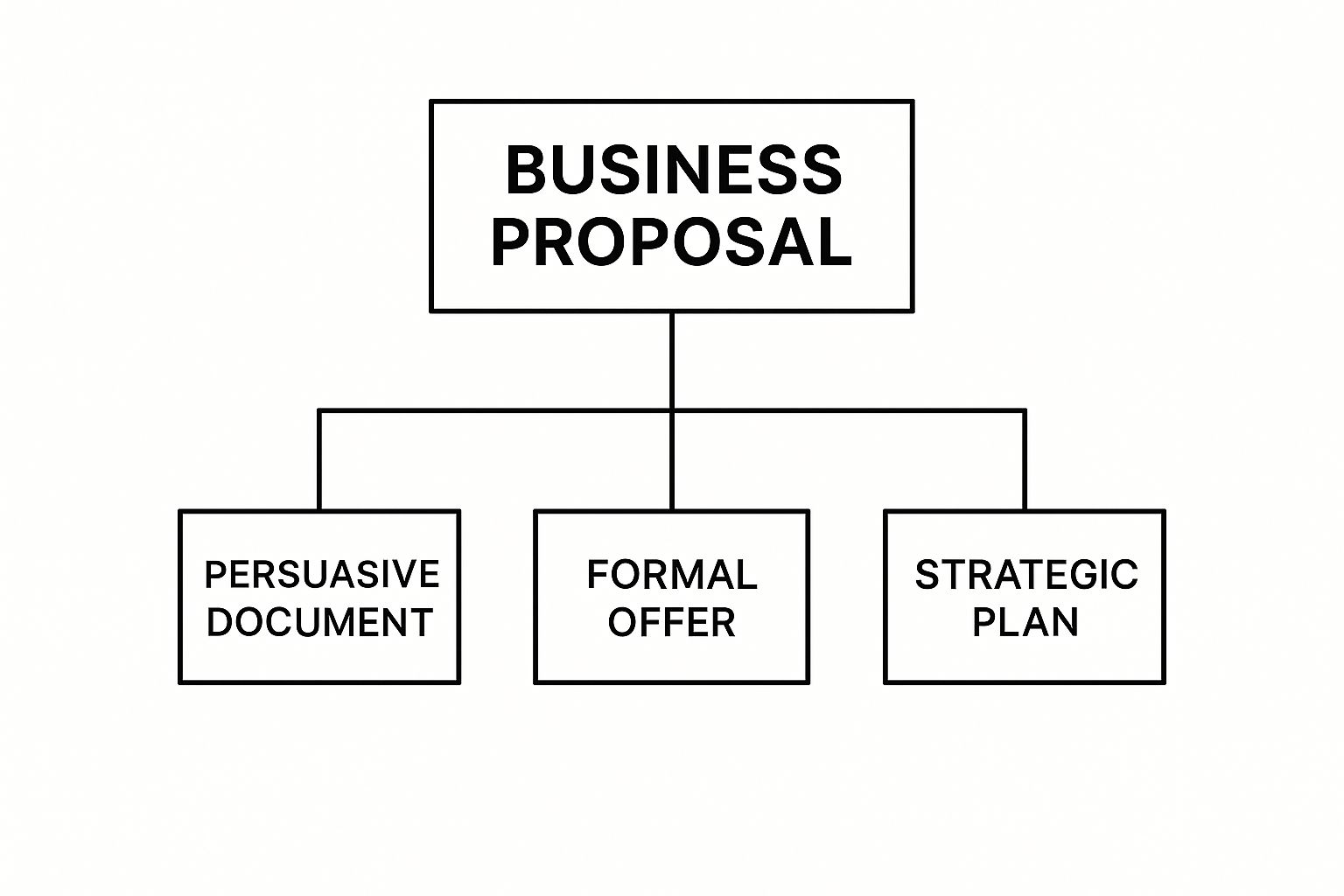
The image above really nails it: a proposal is a mix of a formal offer, a strategic plan, and a compelling argument. Let’s pull back the curtain and look at the essential pieces that make this machine run.
The Executive Summary: The Hook
Let’s be honest, your potential client is busy running their Shopify store. The executive summary is your one shot—your thirty-second elevator pitch—to convince them this proposal is worth their time. It’s the very first thing they’ll read, and it has to land perfectly.
Its job is simple: prove you get it. Show them you understand their #1 goal and have a clear path to get them there.
An effective executive summary is a miniature version of the whole proposal. It should hit the high points: the client's core problem, your big-picture solution, and the incredible results they can expect. It makes them want to keep reading.
Shopify Example: "This proposal lays out our plan to boost your Shopify store's conversion rate by 15% within the next three months. We'll achieve this by redesigning your product page template and introducing a one-page checkout, which will slash cart abandonment and increase your average order value."
The Problem Statement: Building Empathy
Before you can be the hero with the solution, you have to show you truly understand the villain. This section is where you demonstrate real empathy. You need to describe their business pains even better than they can.
Forget generic fluff. Get specific. Connect their broad business frustrations to the nitty-gritty details of their Shopify setup.
- Vague Problem: "Your Shopify site is slow."
- Specific Problem: "Your current theme's bloated code and oversized images are causing a 7-second mobile load time. This directly contributes to a 40% bounce rate, meaning you're losing nearly half your potential customers before they even see a product on your Shopify store."
When you frame the problem with real data and tangible consequences, you instantly change from a salesperson to a trusted expert.
The Proposed Solution: The Cure
Alright, you've diagnosed the problem. Now it's time to present the cure. This is the heart of your proposal. You’ll lay out exactly what you're going to do, how you're going to do it, and most importantly, why it’s the perfect fix for their store.
Talk in their language—the language of business results, not technical jargon.
- Weak Pitch: "Klaviyo integration."
- Winning Solution: "We'll integrate Klaviyo with your Shopify store to create automated email sequences for abandoned carts and new customers. We project this will recover 10-15% of otherwise lost sales and increase customer lifetime value by 25% within six months."
This approach reframes your services from an expense into an investment. For a closer look at how these project-level strategies fit into a larger business framework, check out our guide on building an annual operating plan.
Project Timelines and Pricing: The Blueprint for Trust
Nothing kills a deal faster than confusion or suspicion. This final section is all about radical transparency. A vague timeline or a single, mysterious lump-sum price just creates doubt. You need to build confidence with clarity.
Break the project down into phases with clear milestones. This shows the client you have a solid, organized plan and helps manage their expectations right from the start. Do the same with your pricing. An itemized table removes the mystery and shows the value packed into every dollar.
Here's how you might structure the pricing for a Shopify Markets Pro setup.
Shopify Markets Pro Setup Pricing
| Phase | Deliverable | Cost |
|---|---|---|
Phase 1: Discovery | Market analysis and international compliance check for Shopify | $1,500 |
Phase 2: Setup | Configuration of duties, taxes, and local payment methods in Shopify | $2,500 |
Phase 3: Launch | Storefront localization and currency setup for 3 new markets | $2,000 |
Total Investment | $6,000 |
This kind of detail transforms your proposal from a sales pitch into a trustworthy project blueprint, making it incredibly easy for the client to give you an enthusiastic "yes."
Solicited vs. Unsolicited Proposals for Shopify Projects

When you're trying to land Shopify projects, not all proposals start the same way. Think of it like fishing: sometimes you cast your line where you know the fish are biting, and other times you scout out a promising new spot no one else has noticed.
The same idea applies to the two main types of business proposals: solicited and unsolicited. Each one has a different job to do, and knowing which one to use—and when—is a massive advantage for any Shopify pro. One is a direct response to an invitation; the other is a bold, proactive play.
Solicited Proposals: Responding to a Clear Need
A solicited business proposal is your answer to a direct ask. The Shopify merchant has already figured out they have a problem, raised their hand, and started looking for help. They know what they need, and they're actively shopping for an expert.
This usually comes in the form of a Request for Proposal (RFP), a formal document where they spell out all their project requirements.
Think of a solicited proposal as a job interview you were invited to. The merchant has a specific role to fill, and your proposal is your resume and interview all in one, proving you’re the best agency for the job they've already defined.
Shopify Example: A large apparel brand has outgrown its current e-commerce platform and puts out an RFP for a full migration to Shopify Plus. They need the works—data migration, a custom theme, and multiple app integrations. Your agency sends back a detailed proposal that ticks every box in their RFP, showing off your deep Shopify Plus experience. That's a classic solicited proposal.
Unsolicited Proposals: Creating the Opportunity
On the flip side, an unsolicited business proposal is a pitch you start from scratch. You’re the one initiating the conversation. You’ve spotted a problem or an opportunity for a Shopify merchant that they probably haven't even seen themselves.
This approach takes more digging and a bit of detective work. You aren't just selling a solution; you're first making them aware of a problem they didn't know they had, and then positioning yourself as the only one who can fix it.
Shopify Example: You find a direct-to-consumer brand on Shopify with great products, but their website is slow, clunky, and a nightmare on mobile. You could put together an unsolicited proposal explaining how a Shopify theme optimization and a cleaner mobile checkout could realistically boost their conversion rates by 20%. By highlighting the revenue they're likely losing, you're creating the opportunity yourself.
When to Use Each Approach
Knowing the difference is one thing, but using them smartly is what really matters. Each proposal type has its own pros and cons, making them better suited for different situations in the Shopify world.
I've put together a quick table to help you see the strategic differences at a glance.
Solicited vs Unsolicited Shopify Proposals
| Aspect | Solicited Proposal | Unsolicited Proposal |
|---|---|---|
Client Awareness | The Shopify merchant knows they have a need and is actively looking for a fix. | The Shopify merchant is likely unaware of the problem or opportunity you've found. |
Competition | Usually high. You're almost certainly up against other Shopify agencies. | Typically low. You're the one starting the conversation. |
Success Rate | Generally higher because the client has a confirmed budget and intent to hire. | Lower, as it can feel like a cold pitch if it isn't deeply researched. |
Best For | Responding to RFPs and bidding on jobs from the Shopify Expert Marketplace. | Pitching CRO packages, SEO audits, or app integrations to brands you admire. |
Your choice between a solicited or unsolicited approach will really depend on your business development strategy and the kinds of opportunities you find in the Shopify ecosystem.
Practical Proposal Examples for Shopify Services
Knowing the theory is great, but seeing it in action is where things really click. Let's move from concept to reality and break down some practical examples for common services you might offer in the Shopify world.
These aren't just copy-paste templates. Think of them as strategic snippets showing how to frame the three most critical parts of any proposal: the Problem, the Solution, and the Investment. You can adapt this language to fit your own client conversations. For more structured starting points, you can also check out these sales proposal templates which provide a great foundation.
Example 1: Shopify Store Launch
Let's start with a classic scenario: a new direct-to-consumer (DTC) brand selling artisanal coffee beans. They’ve built up a nice following on social media, but they're pre-launch and have nowhere to actually sell their product.
- The Problem: "Artisanal Brew Co. has generated significant pre-launch buzz but currently lacks a dedicated e-commerce platform to convert this interest into revenue. Without a professional, reliable online store, you risk losing that initial sales momentum and creating a frustrating first experience for eager customers. That could damage your brand reputation before it even gets off the ground."
- The Solution: "We will build a fully-featured Shopify store designed to deliver a seamless customer journey from discovery to checkout. This includes a custom-branded theme that reflects your unique aesthetic, a streamlined product page layout to highlight your coffee selections, and an optimized mobile checkout process. By launching on Shopify, you gain a powerful platform that can scale with your growth, from your first sale to your ten-thousandth."
- The Investment:
- Shopify Theme Customization & Setup: $3,500
- Product Catalog Configuration (up to 25 SKUs): $1,000
- Payment Gateway & Shipping Integration: $500
- Total Project Investment: $5,000
Example 2: SEO and Content Strategy
Now, let's look at an established Shopify store selling handmade leather goods. Their sales have hit a plateau. They’re relying too much on paid ads and need a way to bring in more organic, high-intent traffic to grow sustainably.
- The Problem: "Your Shopify store's current reliance on paid advertising creates a high customer acquisition cost and unpredictable revenue. Our initial audit reveals a 75% drop-off in organic traffic after the first page of search results for key terms like 'handmade leather wallets.' This is a huge missed opportunity to attract qualified buyers who are actively searching for what you sell."
- The Solution: "We propose a comprehensive Shopify SEO and content strategy to increase your organic visibility. Our approach includes on-page optimization for all product and collection pages, a technical SEO audit to fix site speed and indexing issues, and a three-month content plan targeting long-tail keywords. This will establish your store as an authority in the space and drive consistent, cost-effective traffic."
- The Investment:
- Comprehensive Shopify SEO Audit: $1,200
- On-Page & Technical Implementation: $1,800
- 3-Month Content Strategy (2 blog posts/month): $2,000
- Monthly Retainer: $1,667/month
By translating technical services like "keyword research" into business outcomes like "attracting qualified buyers," you make your value infinitely more compelling. The client doesn't buy the process; they buy the result.
Example 3: Custom Shopify Functionality
Finally, imagine a large Shopify merchant that sells subscription boxes. Their team is drowning in manual work, spending hours bundling products for custom orders. The process just isn't scalable.
- The Problem: "Your team is currently spending over 20 hours per week manually assembling custom subscription boxes, leading to fulfillment delays and a high risk of human error. This operational bottleneck isn't just costly in terms of labor; it's actively limiting your ability to scale your popular custom box offering on Shopify and capping your potential revenue growth."
- The Solution: "We will develop a custom Shopify application to automate your product bundling process. This tool will integrate directly into your Shopify admin, allowing customers to build their own boxes on the front end while generating automated pick lists for your warehouse team. This will eliminate manual data entry, reduce fulfillment time by an estimated 90%, and allow you to scale this offering without limitation."
- The Investment:
- Phase 1: Discovery & Scoping: $2,500
- Phase 2: Custom App Development: $9,000
- Phase 3: Integration & Testing: $3,500
- Total Project Investment: $15,000
While these examples are all about getting that "yes," a signed proposal often becomes the foundation for a legally binding document. To see how the terms of a proposal are formalized after a successful pitch, check out these business contract examples.
Best Practices That Increase Your Proposal Win Rate

Having a solid structure is just the starting line. If you really want to stand out in a Shopify merchant’s crowded inbox, your proposal needs to do more than just list services. It has to use a bit of psychology and strategy to make signing it feel like the smartest business decision they could possibly make.
The first and most critical step? Ditch the generic templates. A winning proposal feels like it was written for one client and one client only. It shows you’ve done your homework and genuinely get their unique corner of the Shopify universe.
Personalize Everything
The fastest way to get your proposal deleted is to make it feel like a copy-and-paste job. Before you write a single word, immerse yourself in the client’s world. Browse their Shopify store, read their "About Us" page, and see what they're up to on social media.
This deep dive lets you mirror their brand voice and speak directly to their specific challenges. Instead of a vague, generic offer, you can tailor your pitch to what actually keeps them up at night.
- Generic: "We offer Shopify theme customization services."
- Personalized: "We noticed your mobile checkout has a few extra steps that might be causing cart abandonment. We propose a streamlined one-page checkout that reflects your minimalist brand aesthetic and could significantly boost mobile conversions on your Shopify store."
That level of detail proves you're not just another service provider. You’re a proactive partner who’s invested in their success from day one.
Speak in Benefits, Not Features
Shopify merchants are business owners first. They aren't buying technical services; they're buying business outcomes. Your proposal's language absolutely has to reflect this reality by translating every feature into a tangible business benefit.
Cut the jargon and focus on the results your work will actually deliver. Frame everything in terms of more revenue, better customer loyalty, or saved time.
Instead of saying you'll "implement advanced segmentation in Klaviyo," tell them you'll "double the value of their email subscribers by sending targeted offers that drive repeat purchases." The first is just a task; the second is a result they can take to the bank.
This benefit-driven approach reframes your services from an expense into a powerful investment in their store’s growth.
Weave in Social Proof
Trust is the currency of business. For a Shopify merchant, hiring an agency or freelancer is a big risk. You can instantly lower that perceived risk by sprinkling social proof throughout your proposal.
Social proof is a powerful endorsement. It shows that other businesses—just like theirs—have trusted you and seen fantastic results.
Here are a few powerful ways to do this:
- Direct Testimonials: Drop in a quote from a previous Shopify client. For example: "Working with them was a game-changer. Our conversion rate on Shopify jumped by 22% in the first quarter alone." - Founder, Brand X.
- Mini Case Studies: Briefly outline a problem, the solution you provided, and the measurable result for another Shopify store.
- Logos: A simple bar of logos from past Shopify clients can build credibility in an instant.
This kind of evidence makes your claims believable and gives a potential client the reassurance they need to move forward.
Make a Clear Call-to-Action and Follow Up
Don't leave the client guessing what comes next. End your proposal with a clear, direct, and simple call-to-action (CTA). Tell them exactly how to accept the proposal, whether it's signing electronically, clicking a link, or booking a call.
Your follow-up game is just as important. The average win rate for business proposals hovers between 30% and 40%, but speed gives you a serious edge. Proposals sent within 48 hours of a client inquiry have a 25% higher chance of being accepted. If you want to dive deeper into these metrics, you can learn more about proposal success rates and find other key insights.
A polite follow-up email a few days after you send the proposal keeps the conversation going and shows you’re still engaged and ready to help.
Common Questions About Shopify Business Proposals
Even when you know what a business proposal is supposed to do, a lot of questions pop up when you're actually trying to build one. When you're in the trenches, trying to land that next big Shopify project, the practical details can feel a bit overwhelming.
This is your no-nonsense FAQ for turning theory into signed contracts.
How Long Should My Shopify Proposal Be?
There's no magic number here. The golden rule is simple: as long as it needs to be, and not a word longer.
A quick proposal for a one-off task, like installing a new app, might only be two or three pages. On the other hand, a comprehensive plan for a full Shopify Plus migration could easily run over 10 pages. The key is to focus on value, not volume. Every single sentence has to work hard to persuade the client.
- Small Projects (Theme tweaks, app setup): Stick to 2-4 pages. That’s enough space to outline the problem, your solution, the price, and why you’re the right person for the job.
- Medium Projects (New store build, SEO strategy): Plan for 5-10 pages. This gives you room for a detailed scope, a clear timeline, and maybe a mini-case study to show you know your stuff.
- Large Projects (Shopify Plus migration, custom app development): These can easily hit 10+ pages. You need the space to break down every phase, technical requirement, and deliverable so there are no surprises.
Think of it this way: your proposal should give the Shopify merchant just enough information to make saying "yes" an easy decision. Cut out anything that doesn't help them get there.
What Pricing Model Should I Use?
Picking your pricing model is one of the most important decisions you'll make. It sets the tone for the project, impacts your bottom line, and shapes how the client perceives your value. For Shopify work, three models are king.
- Fixed-Project Pricing: You quote one flat fee for the whole shebang. This is perfect for projects with a crystal-clear scope, like a standard store setup. Clients love it because the cost is predictable, but it puts all the risk of scope creep squarely on your shoulders.
- Hourly Rate: You bill for the hours you actually work. This is a great fit for ongoing support or projects where the scope is a bit fuzzy, like long-term store management. It’s flexible, but some clients get nervous about the final cost being a mystery.
- Retainer Model: The client pays a recurring fee every month for a set amount of your time or for specific ongoing services, like SEO. This is the holy grail for building stable, long-term relationships and predictable income with Shopify merchants.
Honestly, the best model really depends on the project itself and your relationship with the client.
What Are the Best Proposal Tools?
Trying to piece together proposals in Google Docs or Word is a surefire way to waste time and look unprofessional. Modern proposal software can save you hours and help you create documents that actually close deals.
These tools handle everything from templates and design to e-signatures and even collecting payment.
Here are a few that are popular with Shopify pros:
- **PandaDoc:** A real powerhouse. It’s packed with features like templates, analytics (so you can see exactly when a client opens your proposal), and built-in e-signatures.
- **Better Proposals:** This one is all about creating slick, web-based proposals that look amazing on any device and are dead simple for clients to sign.
- **Proposify:** Fantastic for teams. Proposify helps keep your branding consistent across all your proposals and gives you great insights into your sales pipeline.
Using a dedicated tool just makes you look more polished and seriously streamlines your whole process.
How Do I Follow Up Without Being Annoying?
Ah, the follow-up. It's a delicate dance. You need to stay on their radar without becoming a pest. The trick is to have a simple, professional game plan.
First, set the expectation right in the proposal. Add a "Next Steps" section so they know what’s coming. Then, give them some breathing room—wait about 3-5 business days after sending it before you reach out.
Here’s a simple script you can steal:
Subject: Checking in on the Shopify Project Proposal
"Hi [Client Name],
Hope you had a chance to look over the proposal I sent on [Day].
Just wanted to see if you had any questions I could clear up for you. I'm free for a quick chat this week if that would be helpful.
Best, [Your Name]"
It’s polite, it’s helpful, and it’s not pushy. You're opening the door for a conversation, not just demanding an answer. Sometimes, a gentle nudge is all it takes.
Navigating the world of e-commerce proposals can be complex, but protecting your store from threats shouldn't be. Fraud Falcon offers an automatic fraud prevention solution built for Shopify, helping you block fraudulent orders and reduce chargebacks. Secure your revenue and streamline your operations by installing Fraud Falcon today.