
Understanding your cash flow is non-negotiable for any Shopify store owner. It's the financial lifeblood of your business, determining your ability to pay for inventory, run marketing campaigns, and ultimately, scale your operations. While a profit and loss statement shows profitability, a cash flow projection reveals your actual liquidity and operational health. Without a clear view of money moving in and out, you risk making critical decisions based on incomplete data, leading to stockouts, missed growth opportunities, or even business failure.
This article moves beyond theory to provide practical, real-world guidance. We will break down six distinct cash flow projection example templates, each tailored to a specific need within the Shopify ecosystem. You won’t just see numbers; you'll get a behind-the-scenes look at the strategic thinking and tactical calculations required to build each one for your store.
From mastering daily operations with a 13-week forecast to modeling for a new product launch, you will learn how to:
- Build different types of cash flow forecasts using Shopify data.
- Analyze the data to uncover strategic insights for your store.
- Apply these insights to make smarter, data-driven decisions for your Shopify business.
Each example is designed to be a replicable blueprint, giving you the tools to manage your Shopify finances with confidence and precision.
1. Direct Method Cash Flow Projection
The direct method offers a granular, real-time view of your Shopify store's financial health. Unlike the indirect method, which starts with net income and adjusts for non-cash items, the direct method tracks actual cash moving in and out of your business. It lists major categories of cash receipts (like payouts from Shopify Payments) and cash payments (like payments to suppliers and for Shopify apps). This approach provides a clear and straightforward picture of your cash flow from operations.
For a Shopify store owner, this method is particularly intuitive. It mirrors the day-to-day financial activity you see in your accounts. You’re essentially tracking the literal cash deposits from Shopify Payments, PayPal, and Stripe, and the actual cash withdrawals for inventory, Meta ads, and app subscriptions. This makes it an excellent tool for tactical, short-term financial management.
Practical Shopify Example
Imagine a Shopify store, "Crafty Mugs," that sells print-on-demand t-shirts. Using the direct method, the owner would create a cash flow projection that itemizes specific cash inflows and outflows for the month.
- Cash Inflows:
- Cash from Customers: $12,000 (Projected total payouts from Shopify Payments and PayPal after their processing fees and holds).
- Loan Proceeds: $5,000 (A cash injection from a Shopify Capital loan to fund a new marketing campaign).
- Cash Outflows:
- Supplier Payments: $4,500 (Payments to Printful for cost of goods sold).
- Marketing Spend: $2,500 (Actual cash paid for Facebook & Instagram Ads and TikTok campaigns).
- Shipping Costs: $1,200 (Payments to shipping carriers).
- Salaries & Wages: $1,500 (Payments to a virtual assistant for customer service).
- Shopify Fees: $199 (Monthly Shopify plan, transaction fees, and app subscriptions like Klaviyo and Loox).
This detailed tracking allows the store owner to see precisely that marketing and supplier payments are the biggest cash drains, enabling quicker decisions on ad spend or pricing.
Actionable Takeaways for Shopify Merchants
To implement this method effectively, focus on precision and consistency.
- Automate Your Tracking: Use accounting software that integrates directly with Shopify, like Xero or QuickBooks Online. This automatically pulls in sales data and expenses, minimizing manual entry and ensuring accuracy.
- Categorize Rigorously: Set up specific categories for your cash flows. Instead of a generic "Marketing" expense, create subcategories like "Facebook Ads," "Google Ads," and "Klaviyo" to see which channels provide the best cash return.
- Update Frequently: Review and update your projection weekly. For a fast-moving Shopify business, monthly updates are too infrequent to catch potential cash shortages before they become critical problems.
- Analyze Variances: Compare your projected cash flows to your actual results each week. If cash from customers was 20% lower than projected, dig into why. Was it a failed ad campaign or a delay in Shopify Payments payout? This analysis turns your projection into a powerful strategic tool.
2. Indirect Method Cash Flow Projection
The indirect method offers a strategic, high-level view by reconciling your net income with your actual cash position. It starts with the net income from your profit and loss statement and makes adjustments for non-cash expenses (like depreciation) and changes in working capital (like inventory and accounts receivable). This approach is favored for financial reporting and analysis because it clearly shows why net income and cash flow from operations are different.
For a Shopify merchant, the indirect method is less about day-to-day cash management and more about strategic planning and financial analysis. It helps you understand how profitability translates (or doesn't) into cash in the bank. If you're seeking a loan or investment, this method provides the kind of cash flow projection example that lenders and investors expect to see, as it connects directly to your store's official financial statements.
Practical Shopify Example
Consider a rapidly growing Shopify store, "Glow Skincare," that sells its products directly to consumers and through a few wholesale partners using Shopify B2B. The owner uses the indirect method for their quarterly investor updates.
- Starting Point: Net Income for the quarter is $50,000.
- Adjustments for Non-Cash Expenses:
- Depreciation: Add back $5,000 in depreciation for warehouse shelving and packing equipment. This was an expense on the income statement but didn't use any cash.
- Adjustments for Changes in Working Capital:
- Increase in Inventory: Subtract $20,000. The store bought more inventory to prepare for a Black Friday sale, which used cash but isn't yet an expense (Cost of Goods Sold).
- Increase in Accounts Receivable: Subtract $10,000. This represents sales made through Shopify B2B that have been invoiced but not yet paid by wholesale partners. The revenue is in the net income, but the cash hasn't arrived.
- Increase in Accounts Payable: Add back $7,000. The store received packaging from a supplier but hasn't paid the invoice yet, preserving cash for now.
The final cash flow from operations is $32,000 ($50k + $5k -$ 20k - $10k +$ 7k), revealing a much different cash story than the $50,000 net income suggests.
Actionable Takeaways for Shopify Merchants
To leverage the indirect method, focus on the link between your operations and your financial statements.
- Maintain a Clean Balance Sheet: This method relies heavily on changes in balance sheet accounts. Use a Shopify-integrated accounting app like Xero or QuickBooks to keep your balance sheet accurate and up-to-date.
- Analyze Working Capital Trends: Don't just calculate the numbers; understand the story they tell. Is your inventory value constantly climbing faster than sales? It might mean you're holding too much stock, tying up cash. Are your Shopify B2B receivables growing? You may need to tighten your wholesale payment terms.
- Use It for Strategic Forecasting: The indirect method is powerful for "what-if" scenarios. You can project how a decision to buy more inventory or offer longer wholesale payment terms will impact your cash position, even if it boosts your projected net income.
- Reconcile with the Direct Method: For the most comprehensive view, use both methods. The indirect method provides the "why" behind cash flow changes, while the direct method shows you the "what" and "where" of your daily cash movements. This dual approach provides a complete financial picture for both strategic planning and daily operations.
3. Rolling 13-Week Cash Flow Forecast
The 13-week cash flow forecast is a dynamic, short-term management tool that provides a granular, week-by-week view of your cash position for the upcoming quarter. Unlike a static annual budget, this forecast is "rolling," meaning each week you add a new week to the end of the forecast as the current week is completed. This creates a perpetual 13-week window, making it essential for Shopify stores navigating uncertainty, rapid growth, or tight liquidity. It forces a disciplined focus on immediate cash needs and availability.
For a Shopify store, this method is invaluable for managing the intense cash cycles of e-commerce. It helps you anticipate cash crunches caused by large inventory purchases before Black Friday, plan for significant ad spend, and ensure you have enough cash to cover payroll and supplier payments. This forward-looking view is critical for survival and strategic decision-making in the fast-paced world of online retail.

Practical Shopify Example
Consider a Shopify store, "Summer Styles," that sells swimwear. Heading into the peak spring/summer season, the owner uses a rolling 13-week cash flow projection example to manage a large inventory build-up and an aggressive marketing push.
- Cash Inflows:
- Projected Sales Revenue: Forecasted weekly sales based on last year's Shopify data and current marketing campaign performance, accounting for Shopify Payments processing times.
- Receivables from Klarna/Afterpay: Expected weekly cash settlements from these "buy now, pay later" services.
- Shopify Capital Advance: A planned draw in week 4 to cover a large inventory order from their supplier.
- Cash Outflows:
- Inventory Payments: Large payments scheduled for weeks 5 and 6 to suppliers for summer stock.
- Marketing Spend: Weekly cash outlays for TikTok, Instagram, and Google Ads campaigns, increasing significantly from week 7.
- Payroll: Bi-weekly payments to customer service and fulfillment staff.
- Shipping & Logistics: Variable weekly costs from their 3PL, tied directly to projected sales volume.
- App Subscriptions: Fixed monthly payments for Shopify apps (like a returns manager and upsell app), broken down to a weekly impact.
This detailed weekly forecast reveals a potential cash shortfall in week 6, allowing the owner to proactively draw on their line of credit or delay a non-essential expense to maintain liquidity.
Actionable Takeaways for Shopify Merchants
To leverage the power of a 13-week rolling forecast, prioritize agility and data accuracy.
- Start with Knowns: Begin each weekly forecast by populating it with known, recurring cash flows first, such as your Shopify subscription, app fees, and staff salaries. This creates a reliable baseline.
- Model Scenarios: Don't rely on a single projection. Create best-case, worst-case, and most-likely scenarios for sales and marketing costs. What if your big holiday campaign underperforms by 30%? This helps you build contingency plans.
- Focus on Key Variables: Identify the 2-3 most significant and variable cash items for your store, which are often customer receipts (from Shopify Payments) and marketing spend (on platforms like Meta or Google). Dedicate the most time to forecasting these accurately.
- Track and Refine: At the end of each week, compare your forecast to the actual cash movements. Analyze the variances to understand why your projection was off. This feedback loop will continuously improve the accuracy of your future forecasts, making it a more powerful strategic tool.
4. Scenario-Based Cash Flow Modeling
Scenario-based cash flow modeling prepares your Shopify store for the unpredictable by creating multiple projections based on different potential futures. Instead of a single, static forecast, this method builds best-case, base-case, and worst-case scenarios. By stress-testing your finances against various assumptions, you can understand your store's resilience and identify potential cash crunches before they happen.
For a Shopify merchant, this approach is invaluable for strategic planning. It moves beyond simple sales forecasting to consider external shocks or internal opportunities. What happens to your cash flow if a key supplier doubles their prices (worst-case)? What if a viral TikTok campaign triples your sales (best-case)? This modeling provides a range of possible outcomes, enabling you to build contingency plans and make more robust strategic decisions.
The decision tree below visualizes how a Shopify store might map out different cash flow scenarios based on projected revenue outcomes.
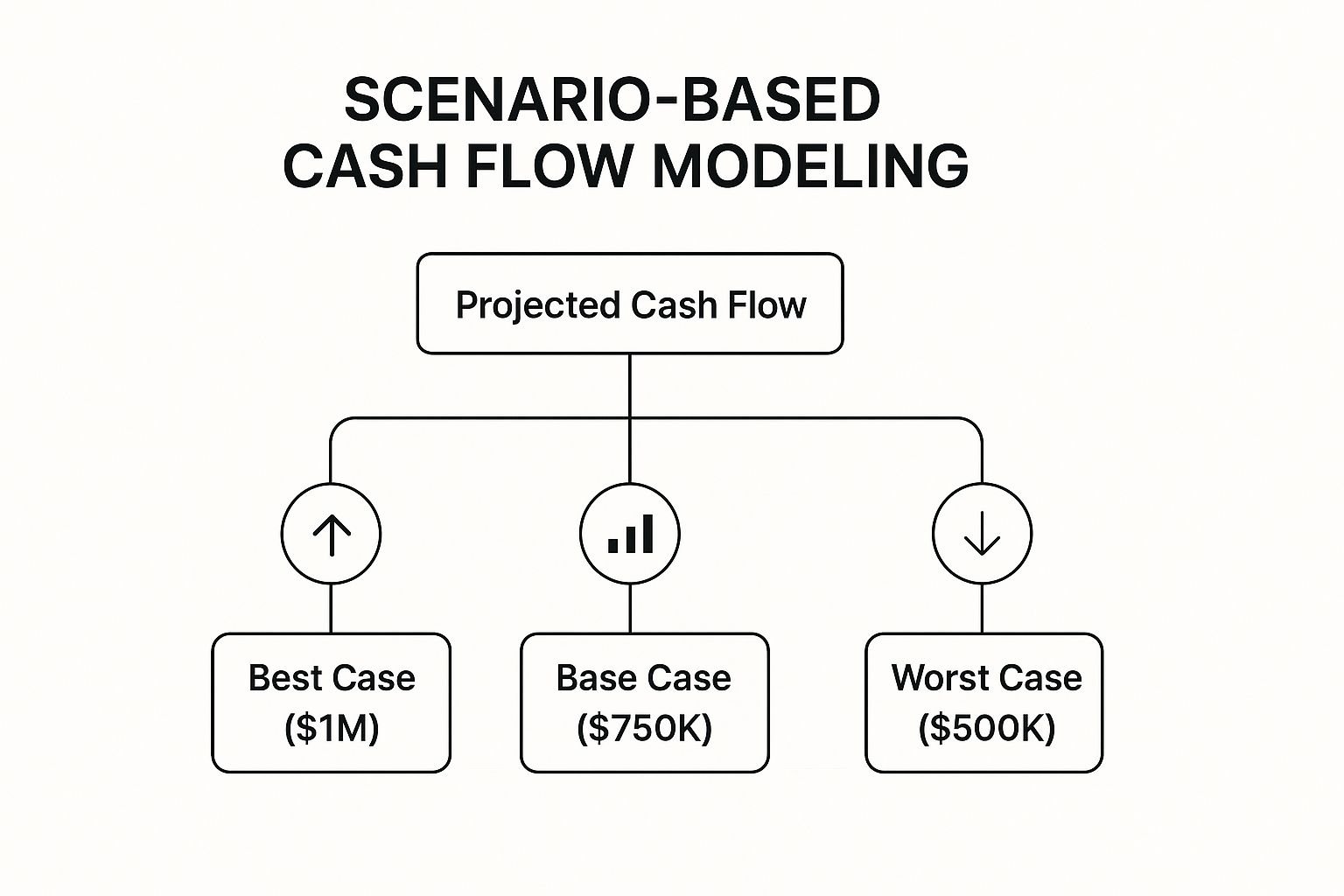
This visualization clarifies the potential financial outcomes, allowing merchants to prepare specific operational responses for each possibility.
Practical Shopify Example
Consider "Holiday Home Co.," a Shopify store specializing in seasonal decor. The owner can use scenario modeling to prepare for the crucial Q4 holiday season. They would create a cash flow projection example for three distinct possibilities.
- Best-Case Scenario:
- Cash Inflows: A viral holiday marketing campaign on Instagram Reels leads to a 50% spike in sales above the forecast.
- Cash Outflows: Increased costs for expedited shipping, higher ad spend to capitalize on momentum, and overtime pay for fulfillment staff.
- Base-Case Scenario:
- Cash Inflows: Sales align with historical data from their Shopify analytics, showing a predictable 25% seasonal uplift.
- Cash Outflows: Standard planned increases in inventory purchasing, marketing budget, and seasonal staff wages.
- Worst-Case Scenario:
- Cash Inflows: A major shipping carrier strike delays deliveries, causing a 30% drop in projected sales and a wave of refund requests processed through Shopify.
- Cash Outflows: The store still incurs costs for pre-purchased inventory and marketing campaigns, leading to a severe cash squeeze.
This analysis equips the owner with a clear understanding of their financial position under various conditions, transforming their annual operating plan into a dynamic, responsive strategy.
Actionable Takeaways for Shopify Merchants
To leverage scenario modeling, focus on identifying key variables and building clear, logical plans.
- Identify Key Drivers: Pinpoint the 2-3 most critical variables that impact your Shopify store's cash flow. These are often customer acquisition cost (CAC), conversion rate, and average order value (AOV).
- Define Plausible Scenarios: Create realistic best-case, base-case, and worst-case scenarios for these drivers. For example, a 20% increase in your Meta Ads CPM for your worst case or a 15% increase in conversion rate for your best case.
- Develop Action Plans: For each scenario, create a corresponding action plan. If the worst case happens, what marketing channels will you cut? If the best case materializes, how will you quickly secure more inventory with a Shopify Capital loan?
- Integrate with Planning: Use these scenarios to inform your high-level strategy and budgeting. This proactive approach is a core component of building a resilient business; you can learn more about how this fits into your annual operating plan.
5. Project-Based Cash Flow Projection
A project-based cash flow projection isolates the cash inflows and outflows tied to a specific initiative in your Shopify store. Instead of looking at the entire business, this method creates a financial mini-narrative for a single project, like a new product launch or a major marketing campaign. It's essential for evaluating the viability of an investment and managing its financial lifecycle from start to finish.
For Shopify merchants, this is the perfect tool for making strategic growth decisions. Whether you're considering expanding into a new product line, investing in a large batch of inventory for a key sales season, or undertaking a website redesign, a project-based cash flow projection example helps you understand the specific financial impact and potential return on investment before you commit significant capital.
Practical Shopify Example
Consider "Leather Luxe," a Shopify store that sells handmade leather goods and wants to launch a new line of vegan leather bags. This is a significant project with upfront costs and uncertain future revenue. A project-based cash flow projection is created specifically for this launch.
- Cash Inflows:
- Projected Sales: Revenue forecasted specifically from the new vegan bag collection, broken down monthly based on market research.
- Financing: $10,000 from a Shopify Capital loan allocated to fund the new product development.
- Cash Outflows:
- Product Development: $2,000 for sourcing new materials and creating initial samples.
- Initial Inventory Purchase: $8,000 as a one-time payment to the manufacturer for the first production run.
- Dedicated Marketing Spend: $3,000 budget for a product launch campaign, including influencer collaborations, targeted ads, and a new landing page built with a Shopify page builder app.
- Photography & Design: $1,500 for new product photos and marketing creative.
This focused projection allows the owner to see if and when the project will become cash-flow positive and what its peak cash requirement will be ($14,500). This is a critical exercise in business expense tracking for discrete initiatives.
Actionable Takeaways for Shopify Merchants
To leverage this method for growth, treat each major initiative as its own financial entity.
- Define Project Timelines: Every project projection needs a clear start and end date. A Q4 Black Friday campaign might have a 4-month timeline (prep in September, launch in October, run through December), while a new product line might be projected over 12-18 months.
- Align Cash Flow with Milestones: Tie your cash outflows to specific project milestones. For example, cash out for inventory should align with the manufacturer's payment schedule, and marketing spend should coincide with the campaign launch date.
- Build in a Contingency Fund: Projects rarely go exactly as planned. Allocate a contingency reserve (typically 10-15% of total projected outflows) to cover unexpected costs like material price increases or shipping delays. Similarly, for dedicated capital outlays or anticipated large expenses, methods like planning for large future expenses with sinking funds demonstrate the importance of forward-looking cash management.
- Track Project-Specific ROI: Regularly compare the actual cash flows of the project against your projection. This helps you not only manage the current project but also makes your future projections more accurate by learning from real-world performance.
6. Working Capital-Focused Cash Flow Analysis
A working capital-focused cash flow analysis shifts the lens from broad revenues and expenses to the operational assets and liabilities that directly impact liquidity. It emphasizes how efficiently a Shopify store manages its accounts receivable, inventory, and accounts payable to generate or consume cash. For businesses with physical products, mastering working capital is the key to sustainable growth and avoiding cash crunches.
This approach is critical for e-commerce because inventory represents tied-up cash, and the time it takes to collect payments versus paying suppliers can make or break your Shopify business. A projection focused on working capital helps you see the cash impact of holding too much stock or having unfavorable payment terms, moving beyond simple profit and loss to true cash health.

Practical Shopify Example
Consider "Luxe Skincare," a Shopify store that sells high-end products. The owner needs to stock up on inventory months before the Black Friday/Cyber Monday (BFCM) sales period. A working capital-focused cash flow projection example would highlight the cash flow timing gap.
- Cash Inflows:
- Accounts Receivable: Tracking the lag between a sale and receiving funds from payment gateways like Shopify Payments or Affirm (which can be 2-3 days or longer).
- Early Payment Discounts: Projecting increased cash from offering wholesale partners a small discount for immediate payment on large Shopify B2B orders.
- Cash Outflows:
- Inventory Purchases: Large cash payments to skincare labs in August and September for holiday stock.
- Accounts Payable: Scheduling payments to packaging suppliers, ensuring they are not paid earlier than necessary.
- Warehousing Costs: Monthly fees for their 3PL (Third-Party Logistics) provider, which increase with higher inventory levels.
This projection reveals a potential cash shortage in October, even though sales are projected to be strong in November and December. It shows precisely when the cash will be tight due to the large, upfront inventory investment for BFCM.
Actionable Takeaways for Shopify Merchants
To leverage this analysis, focus on optimizing the cash conversion cycle. For more in-depth strategies, you can learn more about effective cash flow management.
- Monitor Key Metrics: Track your Days Sales Outstanding (DSO), Days Inventory Outstanding (DIO), and Days Payable Outstanding (DPO). Your goal is to decrease DSO and DIO while increasing DPO without harming supplier relationships.
- Optimize Inventory: Use an ABC analysis in your Shopify admin or with an inventory app to categorize your products. Ensure your high-value "A" items have optimal stock levels and avoid over-investing in slow-moving "C" items.
- Negotiate Supplier Terms: Talk to your suppliers about extending payment terms from 30 days to 45 or 60 days. Even a small extension can significantly improve your cash position during high-growth periods.
- Explore Financing Options: For real-time adjustments and optimization of working capital, considering external support such as contract factoring services to simplify cash flow management can bridge the gap between paying for inventory and getting paid by customers. This turns future revenue into immediate cash.
6 Cash Flow Projection Methods Compared
| Cash Flow Method | Implementation Complexity 🔄 | Resource Requirements ⚡ | Expected Outcomes 📊 | Ideal Use Cases 💡 | Key Advantages ⭐ |
|---|---|---|---|---|---|
Direct Method Cash Flow Projection | Moderate – detailed record-keeping needed | Medium – requires robust cash tracking | Transparent view of actual cash receipts/payments | Small to medium businesses with simple operations | Clear cash generation picture; intuitive |
Indirect Method Cash Flow Projection | Low to moderate – uses existing financials | Low – leverages accounting statements | Reconciles net income to operating cash flow | Public companies; established businesses | Standardized; shows profit-to-cash relationship |
Rolling 13-Week Cash Flow Forecast | High – frequent weekly updates | High – continuous data input and monitoring | Near-term liquidity visibility and early warning | Companies in distress or rapid growth | Proactive cash management; highly accurate short-term |
Scenario-Based Cash Flow Modeling | High – complex modeling and assumptions | High – analytical skills and tools | Range of probable cash flow outcomes; risk insights | Strategic planning; risk management | Enhances decision making; risk reduction |
Project-Based Cash Flow Projection | Moderate to high – detailed project data | Medium to high – requires project integration | Project-specific cash inflows/outflows visibility | Capital budgeting; project finance | Accurate ROI; aids resource allocation |
Working Capital-Focused Analysis | Moderate – detailed operational data | Medium – cross-department coordination | Improved cash flow predictability via working capital | Businesses with significant working capital needs | Identifies optimization opportunities; liquidity management |
Final Thoughts
We've explored a range of cash flow projection example models, each tailored to specific needs within the dynamic Shopify ecosystem. From the granular detail of the direct method to the strategic foresight offered by scenario-based modeling, the core lesson remains the same: a cash flow projection is far more than a financial document. It's a strategic roadmap for your e-commerce business.
By dissecting each cash flow projection example, you’ve seen how to move beyond simple revenue tracking. You now have the tools to anticipate inventory needs for a seasonal spike, evaluate the real cost of a new marketing campaign, and understand the precise impact of Shopify Payments processing delays on your operational stability. These projections are your early warning system and your growth blueprint, all in one.
Key Takeaways: From Theory to Shopify Reality
Mastering these projections empowers you to make proactive, data-driven decisions instead of reactive, panicked ones. Let’s distill the most critical takeaways for your Shopify store:
- Projections Are Living Documents: As we saw in the 13-week rolling forecast, your projections must be dynamic. Regularly update them with actuals to maintain accuracy and relevance, especially in the fast-paced world of e-commerce where sales can fluctuate dramatically.
- Assumptions Drive Everything: The strength of any forecast lies in the quality of its assumptions. Whether it's conversion rates, customer acquisition costs, or return rates, ground your assumptions in historical Shopify data and realistic market analysis.
- Cash is Not Profit: The indirect method example clearly illustrated this crucial distinction. High sales on paper can be misleading if your cash is tied up in inventory, Shopify B2B receivables, or high transaction fees. Healthy cash flow is the true lifeblood of your store.
Your Actionable Next Steps
Transforming this knowledge into action is the final, most important step. Don't let this be just another article you read; use it as a launchpad.
- Choose Your Model: Start with the model that best fits your immediate need. If you're struggling with day-to-day liquidity, the 13-week rolling forecast is your best bet. If you're planning a major product line expansion, use the project-based projection.
- Gather Your Data: Pull your historical sales data, operating expenses, and payment gateway reports directly from your Shopify admin and connected apps. This is your foundation.
- Build and Iterate: Use the templates and insights from this guide to build your first draft. Don't strive for perfection on the first try. The goal is to create a functional tool that you can refine and improve over time.
Ultimately, each cash flow projection example we've covered serves one primary purpose: to give you, the Shopify store owner, a clear and honest view of your financial health. This clarity builds resilience, enabling you to navigate challenges confidently and seize growth opportunities with precision. Your projection is the narrative of your business's future; it's time to start writing it.
One of the biggest threats to your projected cash flow is fraudulent chargebacks, which can unexpectedly drain your accounts and invalidate your forecasts. Protect your bottom line and keep your projections accurate with Fraud Falcon. Our advanced fraud prevention app for Shopify stops fraudulent orders before they become costly chargebacks, ensuring the revenue you earn is the cash you keep. Secure your cash flow with Fraud Falcon today.