
High shipping costs for heavy items can absolutely crush your profit margins and scare away good customers. If you're running a Shopify store, finding the cheapest way to ship isn't about some single, secret carrier—it's about building a smart, multi-faceted strategy.
This guide unpacks the exact tactics you need. We'll cover everything from optimizing your packaging to leveraging Shopify's built-in tools and, most importantly, choosing the right carrier for each specific order.
Why Shipping Heavy Items Is a Unique Challenge
Shipping standard, lightweight products from your Shopify store is one thing. Shipping heavy or bulky items? That's an entirely different game.
Once an item crosses the threshold of what's considered "heavy"—and that's usually anything over 50 pounds—the rules, pricing structures, and even the available carriers change dramatically. If your Shopify store sells furniture, fitness equipment like kettlebells, or industrial parts, shipping isn't a minor line item; it's a core business challenge you have to solve.
The real difficulty is how carriers calculate their rates. It’s never just about the actual weight on the scale. They factor in dimensional weight, shipping zones, and special handling fees, creating a complex pricing puzzle that can be frustrating to navigate. For example, a Shopify store selling home gym equipment might find that a 55-pound dumbbell set costs far more to ship than its weight suggests if the box is too big, driving up its dimensional weight and your final bill.
The Impact on Your Shopify Store
If you don't get a handle on heavy item shipping, it can directly harm your business in a few key ways. We've all seen it: high, unexpected shipping fees are one of the biggest reasons for cart abandonment. If a customer is ready to buy a $300 piece of equipment but gets hit with a$ 90 shipping fee at checkout, there's a good chance they'll bounce and look for a competitor on Shopify with a better deal.
This creates a constant balancing act for Shopify merchants:
- Profit Margins: You could absorb the high shipping costs to offer "free shipping," but that can easily erase your entire profit on the sale.
- Customer Experience: On the other hand, passing the full, unoptimized cost to the customer can lead to sticker shock and lost sales.
- Operational Complexity: Managing freight carriers or figuring out special handling requirements adds a whole new layer of logistics that you just don't have with standard parcel shipping.
Finding the cheapest way to ship heavy items is more than just a cost-saving measure; it's a real competitive advantage. The Shopify merchants who win are the ones who turn shipping from a liability into a strategic part of their business model.
Throughout this guide, we're going to focus exclusively on the tools and strategies you can use right inside the Shopify ecosystem. From leveraging Shopify Shipping's pre-negotiated rates with carriers like UPS to integrating powerful third-party apps for instant freight quotes, you have a powerful toolkit at your disposal. Our goal is to show you exactly how to use it.
Cracking the Code: How Carriers Price Your Heavy Shipments
If you want to find the cheapest way to ship heavy items from your Shopify store, you first have to get inside the heads of carriers like UPS and FedEx. It's almost never as simple as just weighing a box. A few key factors mix together to create that final price, and getting a handle on them is your best defense for protecting your profit margins.
The single most important concept to nail down is dimensional (DIM) weight. Carriers don’t just care how heavy your package is; they care about how much space it hogs on their trucks and planes. DIM weight is the formula they use to give your box a "theoretical" weight based on its length, width, and height.
Here's the kicker: carriers calculate both the actual weight and the DIM weight, then charge you for whichever is higher. This isn't a negotiation—it's just how modern shipping works.
The Dimensional Weight Trap for Shopify Sellers
Let's say you run a Shopify store selling home decor. You've got two very different products to ship out today:
- Product A: A big, modern lampshade. It's super bulky but light as a feather, weighing only 5 pounds. The box is pretty big, though: 20 x 20 x 18 inches.
- Product B: A set of dense, marble bookends. They're heavy for their size, clocking in at 20 pounds. The box is much more compact at 8 x 6 x 6 inches.
Logic would tell you the 20-pound bookends are going to cost more to ship. But thanks to DIM weight, you'd be wrong.
Using the standard carrier formula (L x W x H / 139), that lightweight lampshade suddenly has a DIM weight of a whopping 52 pounds (20 x 20 x 18 / 139 = 51.79). Since 52 pounds is way higher than its actual 5-pound weight, you're getting billed for a 52-pound shipment. Ouch.
Shopify's own help documentation breaks down how this calculation works right inside the platform.
This just goes to show that you have to think about volume, not just the number on the scale, when you're setting up your shipping rates.
Beyond Weight: The Other Hidden Costs
While DIM weight is a huge deal, carriers love to tack on other surcharges and fees, especially for anything they consider heavy or oversized. Knowing what these are is the only way to accurately forecast your costs.
A few of the usual suspects include:
- Shipping Zones: This is just carrier-speak for distance. A package's journey is broken up into zones, and the higher the zone number, the farther it's going—and the more you're paying.
- Fuel Surcharges: These are variable fees carriers add to deal with changing fuel prices. They're usually a percentage of your base rate and can literally change from week to week.
- Residential Surcharges: It costs carriers more to deliver to someone's house than to a business with a loading dock. This fee gets slapped onto nearly every B2C shipment you send.
- Additional Handling & Oversize Fees: If your box crosses certain thresholds (like being over 50 lbs or longer than 48 inches on one side), get ready for some hefty fees.
For Shopify stores selling furniture, fitness equipment, or large electronics, these fees aren't just one-offs—they're a regular part of doing business. The first step to fighting them is understanding how they all pile up.
These pricing models, built around freight and dimensional weight, have completely changed the shipping game. Rates aren't just about actual weight anymore; they're about volume, which makes your packaging strategy more critical than ever.
For example, data shows that the cost to ship a 71-pound package overnight can swing wildly between carriers. If you choose smartly, you can find savings of up to 85% on expedited heavy shipments. That’s a massive difference, and it all comes down to carrier selection. You can dive into more detailed carrier rate comparisons to see the numbers for yourself and use that knowledge to make smarter choices right in your Shopify settings.
Comparing Shipping Carriers Inside the Shopify Ecosystem
Figuring out which shipping carrier to use is where the real money is saved, especially when you're dealing with heavy items. Right inside Shopify, you get instant access to discounted rates from major players like USPS and UPS through Shopify Shipping. The trick isn't finding one "best" carrier, but knowing which one to pick for a specific product and destination. The cheapest option can change dramatically from one order to the next.
This isn’t about setting one rule and forgetting it. It's about building a flexible strategy. For one order, a flat rate box might be a no-brainer. For the next, a discounted ground service will be the clear winner. By really understanding the strengths of each carrier available to you in Shopify, you can make smarter, more cost-effective decisions on the fly.
This chart really puts it into perspective, showing how the cost per pound drops as you move into heavier shipments and freight becomes the more economical choice.
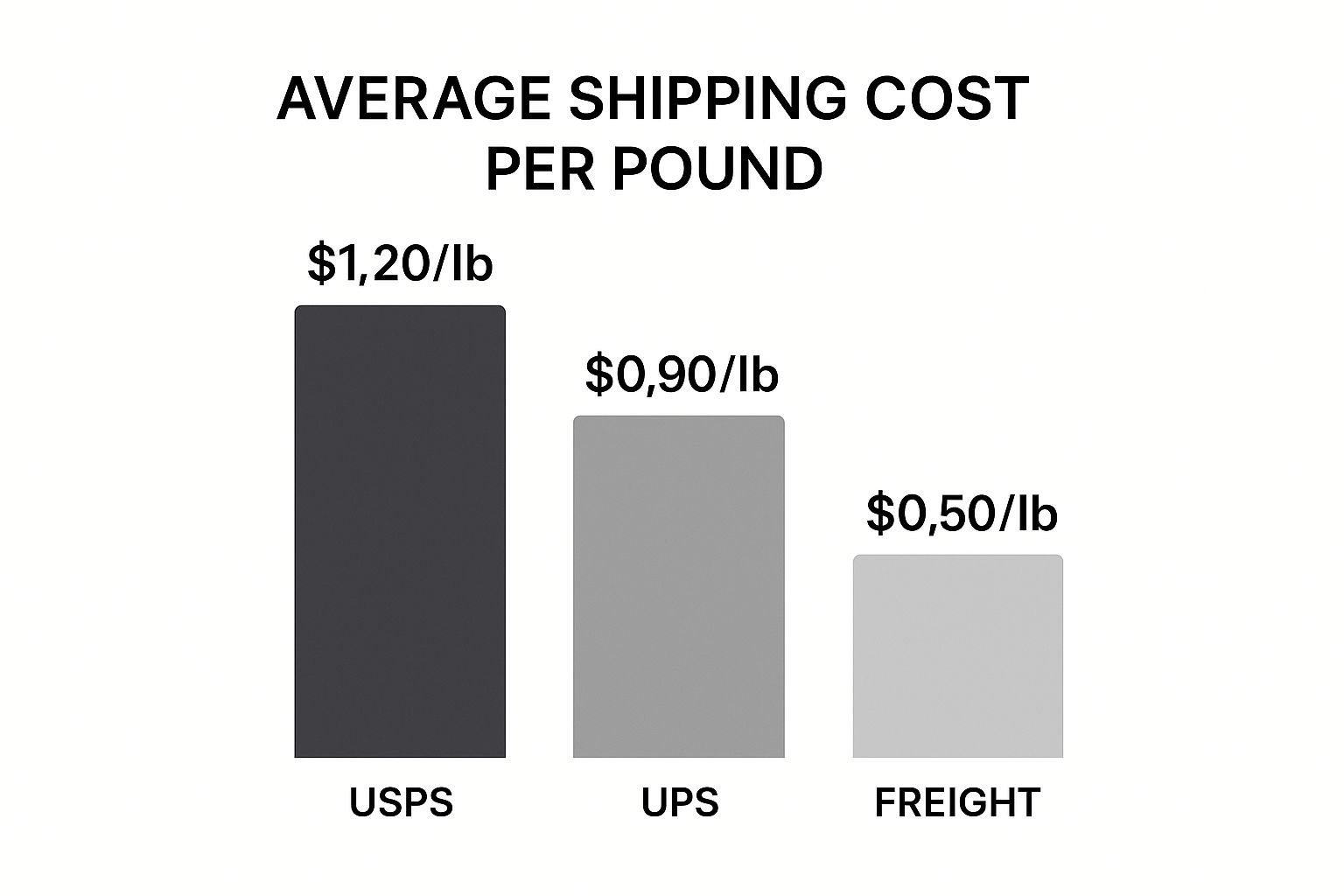
As you can see, standard parcel services are convenient for a reason, but once your items hit a certain weight, freight shipping offers a massive cost reduction per pound.
To give you a clearer picture, I've put together a quick comparison of the major domestic carriers you'll use most often within Shopify.
Domestic Carrier Comparison for Heavy Items (from Shopify)
| Carrier | Best For | Max Weight (Shopify Shipping) | Key Advantage |
|---|---|---|---|
USPS | Dense, heavy items under 70 lbs that fit in Flat Rate boxes | 70 lbs | Predictable, flat-rate pricing nationwide |
UPS | Items between 70-150 lbs or bulky items | 150 lbs | Deeply discounted ground rates via Shopify |
FedEx | (Requires third-party app or own account) | (Varies by service) | Often competitive for express or specialty items |
This table should help you quickly decide which carrier to look at first based on your product's weight and size. Now, let's dive into how to get the most out of them.
Unlocking USPS Strengths for Heavy Items
Most people think of USPS for lightweight packages, but they have a secret weapon for certain heavy items: Priority Mail Flat Rate boxes. If your product is dense and fits snugly into one of their standard boxes, this is often the cheapest way to ship anything up to 70 lbs.
For example, your Shopify store sells fitness gear. You need to ship a 60 lb kettlebell that fits perfectly into a USPS Large Flat Rate box. The price is the same whether it's going one state over or clear across the country. You completely sidestep dimensional weight pricing and zone surcharges, which makes your shipping cost predictable and budget-friendly.
The catch? Once your item goes over the 70 lb limit or is just too bulky for a flat rate box, USPS pricing gets a lot less attractive very quickly.
Leveraging UPS Ground Through Shopify Shipping
For those items that are too big for flat rate boxes or weigh between 70 and 150 lbs, UPS Ground is your workhorse. The rates you get through Shopify Shipping are significantly lower than what you'd pay walking into a UPS Store, giving you a serious advantage.
Here’s a real-world scenario for a Shopify merchant. Your store is based in California, and you get an order for a 50 lb dumbbell set from a customer in New York. The box is way too big for a USPS Flat Rate option.
- Retail Rate: Shipping this via UPS Ground at a retail counter could easily run you over $100.
- Shopify Shipping Rate: With your pre-negotiated discount, the cost through Shopify might be closer to $75. That's an instant 25% savings.
This is exactly where UPS shines—its reliable and cost-effective ground network for the heavy parcels that fall outside the USPS sweet spot.
The real power of Shopify Shipping is having discounted rates from multiple carriers in one place. You can instantly compare USPS and UPS for every single order, ensuring you never overpay.
When to Go Beyond Shopify Shipping with Third-Party Apps
Shopify Shipping is a fantastic starting point, but if your store has complex needs or you're moving seriously heavy inventory (over 150 lbs), the Shopify App Store is your next stop. Third-party apps can unlock even deeper discounts and more advanced shipping logic.
Think about these situations where an app becomes almost essential:
- Real-Time Rate Shopping: Apps can automatically compare rates from a wider pool of carriers right at checkout, so your customer always sees the most accurate and cheapest option.
- Deeper Carrier Discounts: Some apps connect to your own carrier accounts or offer their own negotiated rates, which can sometimes beat the standard Shopify Shipping discounts.
- Freight and LTL Integration: If you sell items over 150 lbs, you're in freight territory. You need Less-Than-Truckload (LTL) options. Apps like ShipperHQ can integrate freight quoting directly into your checkout process, which is a total game-changer.
To put some numbers on it, in 2023, the average cost to ship a 100-pound package in the US was around $150, but that number fluctuated wildly. For domestic parcels over 10 pounds, UPS Ground was often the most economical. For those dense items up to 70 pounds, USPS Priority Mail flat-rate options offered a capped price that was hard to beat. Anything heavier, and LTL freight services delivered significant savings over standard parcel carriers. You can dig into a more detailed breakdown of how carrier rates vary for heavy items and learn more from the full analysis.
Mastering Your Packaging to Lower Shipping Costs
When it comes to shipping heavy items, your packaging is a powerful, yet often overlooked, lever you can pull to control costs. For Shopify merchants, a sturdy box is just the starting point. The real savings are found in smarter packaging techniques that strategically slash both the actual weight and, more importantly, the dimensional weight of every single shipment.
This isn't just about protecting your products; it's about directly boosting your profit on every single order. A few simple changes can lead to a big drop in your shipping expenses, making your pricing more competitive and improving your bottom line.
Eliminate Wasted Space and Weight
The first rule of cost-effective packaging is to make your boxes as compact as possible. Every inch of empty space filled with heavy dunnage (that’s your packing material) is an inch you're paying to ship. The goal is to strike that perfect balance between product protection and package efficiency.
Here are a few techniques I’ve seen work wonders for Shopify stores:
- Custom-Fit Your Boxes: Ditch the one-size-fits-all approach. If you have a few standard product sizes, it’s worth investing in boxes that fit them snugly. You only need enough room for a bit of lightweight padding.
- Use Lightweight Dunnage: Heavy materials like foam inserts or wads of paper are just adding to your bill. Switch to ultra-lightweight alternatives like air pillows or bubble wrap. They provide excellent protection for a fraction of the weight.
- Reinforce Smartly: Don't just add more cardboard. Use high-quality packing tape and apply it with the H-tape method—sealing all edges and the middle seam. This adds a ton of strength without adding significant weight or bulk.
The choice of what you pack with is absolutely fundamental. It’s worth taking a look at an essential overview of packaging materials to make sure you're using the most cost-effective and protective options for what you sell.
Shopify Case Study: Cutting Costs by 15%
Let’s look at a real-world Shopify example. A Shopify store specializing in heavy cast iron cookware was getting killed by astronomical shipping fees. Their skillets, while super durable, were being sent in oversized standard boxes. To stop them from moving, the team was packing them tightly with dense, heavy craft paper.
The owner decided to completely rethink their packaging.
They worked with a supplier to create custom-sized, double-walled corrugated boxes that left less than an inch of clearance around each skillet. Then, instead of that heavy paper, they switched to lightweight, inflatable air pillows.
It was a small change that had a massive impact.
The result? By making their packaging more compact and switching to lighter dunnage, the store cut its average shipping cost by a staggering 15%. That saving went directly to their bottom line, turning a shipping headache into a genuine competitive advantage.
How Smart Packaging Impacts Your Bottom Line
Strategic packaging isn't just a logistical task; it's a financial one. Every single dollar you save on shipping is a dollar added to your profit margin. These savings compound quickly, especially if you’re a high-volume store.
Managing these expenses carefully is crucial for business health. Integrating these packaging savings into your overall financial plan is much simpler when you have a clear view of all your expenditures. For a deeper dive, our guide on cash flow management can help you see how shipping cost reductions fit into the bigger picture of your store's finances.
Ultimately, getting your packaging right is one of the most direct ways to find the cheapest way to ship heavy items. It gives you control over dimensional weight, cuts your material costs, and gets your products to customers safely without you having to overpay for the journey.
Navigating LTL Freight Shipping for Your Shopify Store
The moment your products get too big or too heavy for the usual suspects like UPS or USPS, you've officially entered the world of freight. For most Shopify merchants, this means getting familiar with Less-Than-Truckload (LTL) freight. Knowing when to make that leap is the secret to finding the cheapest way to ship truly heavy items.
Think of it as leveling up your shipping game. Parcel carriers are great for boxes you can reasonably lift and move. LTL freight, on the other hand, is built for the big stuff—items that need to be on a pallet or in a crate. The beauty of LTL is that your shipment shares truck space with others, so you're only paying for the footprint your pallet takes up, not the whole truck.
The 150-Pound Rule of Thumb
When is it time to stop trying to make parcel shipping work? The magic number in the logistics world is 150 pounds. As soon as a single shipment, or a bunch of items going to the same customer, crosses that threshold, parcel carriers either tap out or their surcharges make the cost astronomical.
For example, a Shopify store selling a 200-pound solid oak desk could try breaking it down into multiple, still-very-heavy boxes and sending it via a standard carrier, but you’d be looking at a shipping bill that would make your eyes water. This is exactly the scenario where LTL freight isn't just an option; it's the only sensible one.
Getting the Lingo Right
Before you can even think about getting an accurate freight quote, you have to speak the language. Nailing these key terms is non-negotiable if you want to avoid costly surprises.
- Freight Class: This is a number between 50 and 500 that classifies your shipment. It’s based on a combination of density, how easy it is to stow, handling requirements, and liability. A dense, tough item like a pallet of steel components will have a low class (and be cheaper to ship). A bulky but fragile item like a huge decorative mirror? That’ll have a high class and cost more.
- NMFC Code: This stands for National Motor Freight Classification. It’s a specific code that corresponds to a freight class and tells the carrier exactly what you’re shipping in standardized terms.
- Bill of Lading (BOL): This is the most critical piece of paper in the whole process. The BOL acts as a receipt for your goods, a contract with the carrier, and a document of title. It spells out what’s being shipped, where it came from, and where it’s headed.
A word of warning from experience: getting your freight class or NMFC code wrong can result in the carrier hitting you with expensive re-classification fees after they've already picked up your shipment. Always, always double-check these details.
Bringing LTL Freight to Your Shopify Checkout
For a long time, the biggest headache for Shopify store owners was figuring out how to offer freight shipping without a ton of manual work. You can't just slap a flat rate on a 300-pound custom dining table. The cost to ship it will vary wildly depending on whether it's going to a warehouse in Los Angeles or a residential address in rural Montana that needs a liftgate.
This is where specialized Shopify apps become your best friend.
Imagine your Shopify store sells large, executive office desks. A customer is ready to buy, but your standard shipping rules are useless. If you have to manually quote every single freight order, you're creating a massive bottleneck that will absolutely kill your conversion rate.
This is where tools like ShipperHQ or Freightquote by C.H. Robinson come into play. These apps plug right into your Shopify checkout. When a customer adds a freight-sized item to their cart, the app pings multiple LTL carriers in real-time. It pulls back accurate, live shipping quotes based on the item's weight, freight class, and the customer's delivery address.
This creates a seamless experience, giving your customers the real shipping cost right then and there. No friction, no sticker shock.
On a related note, once you're moving valuable freight, security becomes a top priority. Understanding the role of high-quality container seals for cargo security is a crucial step in protecting your goods and meeting shipping regulations.
Finally, dealing with higher shipping costs and potentially longer payment cycles can put a strain on your finances. To keep your business healthy, it’s a good idea to sharpen your cash flow management skills. By automating the quoting process and securing your cargo, you can make buying a massive desk from your store feel just as simple as buying a pen—all while protecting your profit margins.
Common Questions About Shipping Heavy Items
Shipping anything heavy can feel like a maze of confusing rules and surprise fees. But once you get the hang of it, you can find some serious savings for your Shopify store. Let's tackle some of the most frequent questions merchants have.
What's the Best Way to Ship Something Weighing 50 Pounds?
For a 50-pound package, you've got a couple of solid options, and the best one really boils down to the item's size and where it's headed.
- Dense and Compact Items: If you can squeeze your 50-pound product into a USPS Priority Mail Large Flat Rate box, do it. This is almost always your cheapest bet. You get a single, predictable price no matter the destination, which lets you sidestep those pesky dimensional weight calculations. It’s a perfect fit for things like dumbbell sets or small, heavy machine parts.
- Bigger, Awkwardly Shaped Items: When flat-rate isn't an option, UPS Ground through Shopify Shipping is your best friend. The discounts Shopify has pre-negotiated are significant, making UPS incredibly competitive for packages in the 25-70 pound range that are too bulky for a standard box. For instance, a Shopify store selling specialized car parts would almost certainly find UPS Ground to be the most budget-friendly way to ship a 50-pound exhaust system.
How Can I Cut Costs on Items Over 70 Pounds?
Once your packages tip the scales past 70 pounds, you've officially left USPS territory. Now you're in the world of carriers built for serious weight, and ground service is almost always the way to go.
Your go-to should be UPS Ground, which handles packages up to a hefty 150 pounds right through your Shopify Shipping dashboard. The discounts are real, and the service is reliable. If you're consistently shipping items this heavy, it’s also a good idea to look into third-party Shopify apps that might offer even better negotiated rates with carriers like FedEx.
Is It Cheaper to Ship Heavy Stuff with UPS or FedEx?
Ah, the classic showdown. And the honest answer is: it depends.
Historically, UPS Ground has usually been the more wallet-friendly choice for shipping to residential addresses, especially when you factor in the Shopify Shipping discounts. FedEx Ground, on the other hand, often has a slight edge for business-to-business deliveries.
The Bottom Line: For most Shopify stores shipping to customers' homes, UPS Ground is typically the cheaper and more straightforward option for heavy packages. But don't take it for granted—always compare the rates for your specific shipment. Surcharges and shipping zones can change everything.
Should I Use My Own Boxes or the Carrier's?
Using your own packaging is almost always the smarter financial move, with one big exception: flat-rate shipping.
- Use USPS Flat Rate Boxes any time your heavy item fits snugly inside. It’s simple, cost-effective, and takes the guesswork out of pricing.
- Use your own custom-sized boxes for everything else. This is all about minimizing dimensional weight. By eliminating empty, wasted space, you reduce the "billable weight" that carriers like UPS and FedEx use to calculate your final cost.
Buying your own boxes in bulk might feel like an upfront expense, but it pays for itself over and over again by keeping your shipping bills down.
How Do I Handle International Shipping for Heavy Products?
Going global with heavy items adds a whole new layer of complexity, so finding affordable channels is key. For packages up to 44 pounds, EMS (Express Mail Service) can be a great, cost-effective option because it uses local postal networks for the final delivery.
But for items weighing up to 70 pounds, USPS Priority Mail International is often the winner. Its flat-rate options and negotiated discounts can save you a staggering 40-50% compared to express couriers. Services like UPS Worldwide Saver are also in the mix, with prices that depend on speed and distance. You can find more insights on international shipping channels to see what makes the most sense for your global customers.
What's the Single Biggest Mistake Merchants Make with Heavy Shipping?
The most common—and most expensive—mistake is completely ignoring dimensional weight. So many merchants focus only on what the scale says and then get blindsided by a shipping bill that's double what they anticipated.
For a Shopify store selling large, decorative baskets, you might pay more to ship a 10-pound basket than a 40-pound set of weights. Why? Because the basket's box takes up a massive amount of space in the truck. Always calculate both the actual weight and the dimensional weight to know what you'll actually be charged.
And while you're optimizing shipping, don't forget to secure your payments. High-value orders often go hand-in-hand with heavy items, making them a prime target for fraud. Our guide on how to improve your Shopify Payments fraud protection offers crucial strategies to protect your revenue.
Protecting your store from fraud is just as important as keeping shipping costs down. Fraud Falcon lets you automatically block bad orders with custom rules, slashing chargebacks and securing your bottom line. Don't let fraudsters steal the profits you work so hard to save. Install Fraud Falcon today and start your 14-day free trial.